
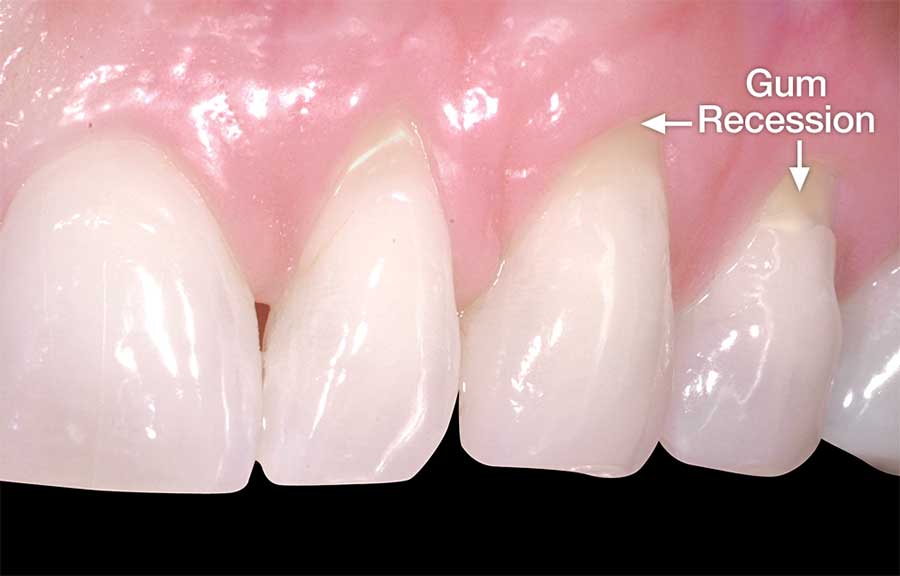
Gum recession is something we see fairly often at our West Roxbury dental practice, and while it can start as a cosmetic concern, it usually has broader implications for long-term oral health. When recession progresses, gum grafting, also referred to as gingival grafting, becomes a practical and predictable way to restore tissue and protect exposed root surfaces.

Healthy gum tissue acts as a protective barrier around the teeth. When that tissue begins to recede, the underlying root becomes exposed. Patients will often notice that their teeth appear longer or feel more sensitive to temperature changes.
Recession can develop for several reasons. Inconsistent oral hygiene can allow plaque to accumulate along the gum line, while overly aggressive brushing can wear the tissue away. Mechanical irritation from appliances or habits can also contribute. In time, once the root is exposed, it becomes more vulnerable to decay, sensitivity, and further tissue loss.
During the procedure, new tissue is placed in areas where the gum has receded. The goal may be to reinforce the gum line, prevent additional recession, or in some cases, cover exposed root surfaces for both protection and aesthetics.
The grafting tissue can come from a few different sources. In many cases, it is taken from the patient’s palate. Alternatively, tissue may be sourced from an adjacent area or from processed donor material. Once the area is numbed, the tissue is carefully positioned and secured with very fine sutures.
Healing occurs through the body’s natural integration process, where new blood vessels form and connect the graft to the surrounding tissue.
The approach depends on the clinical objective. A free gingival graft is often used to thicken the gum tissue and prevent further recession, particularly in less visible areas. When the goal is to cover exposed roots, a more advanced technique may be used to improve both function and appearance.
Both approaches are well-established and generally produce consistent, reliable outcomes when properly indicated.
Grafting procedures are performed under local anesthesia and are typically well tolerated. Post-operative discomfort is usually mild and short-lived. Patients are often advised to follow a soft diet for several days and to avoid brushing directly over the treated area during early healing.
Follow-up visits allow us to monitor healing and ensure the graft is integrating as expected.
A successful gum graft can significantly reduce sensitivity, protect against root decay, and stabilize the gum line. It can also improve the overall appearance of the smile by restoring more natural proportions.
Long-term success depends on maintaining consistent oral hygiene and addressing any contributing factors that led to the recession in the first place. With proper care and routine checkups with your West Roxbury dentist, grafted areas tend to remain stable and support overall periodontal health.